|
Transplantation: A Remarkable Success Story
Organ transplantation is a unique type of treatment. People committed
to a lifetime of dialysis treatment due to kidney failure can
be freed from this punishing and costly ordeal through a kidney
transplant. Success rates of transplantation are very high: recent
statistics show that over 80% of transplanted kidneys are fully
functioning after five years. This compares with just 34% of patients
on renal dialysis surviving for the same period.
For critically ill patients a transplant operation can be a life-saver.
Some 77% of heart transplant patients are enjoying a full and
active life after five years.
Not only is transplantation of incalculable benefit to patients
in terms of human life, but it is also a cost-effective treatment.
The cost of a kidney transplant, for example, is roughly equal
to just two years of renal dialysis treatment. Even including
the price of after-care anti-rejection drugs, the cost of transplantation
is significantly less, as well as being a much better solution
for most patients.
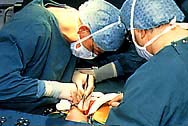 Major developments in transplant surgery mean more desperately-ill
people can benefit than ever before.
Medical Advances
Over the past 15 years major developments in transplant surgery
mean that many more desperately-ill people can benefit than ever
before. As well as new surgical techniques, more effective medicines
such as cyclosporin are available to protect transplanted organs
from rejection by the body.
Today, babies as young as a few weeks old can receive an organ
transplant. Also, patients suffering from diabetes and other diseases
such as cystic fibrosis are now considered safe recipients. Men
and women in their late fifties, sixties or even seventies can
now be given a new lease of life through transplantation.
As a result of this success, 15% more organs are needed each year
to meet demand. Sadly, this rise has not been matched by an increase
in the number of available organs. So while science and technology
has made it possible to save more lives, a desperate shortage
of human organs for transplantation means that waiting lists continue
to grow.

15% more organs are needed each year to meet demand. Source: Eurotransplant/UKTSSA
Waiting Lists
In the USA alone there are more than 30,000 people currently on
the official waiting list. In the UK this figure is nearly 6,000
and in other European countries the figures are proportionately
high. For kidneys alone, it is estimated that 400,000 people could
benefit from a new kidney if there were that number available.
The crisis is so acute that one-third of people awaiting a heart
transplant will die within 12 months unless they recieve a new
organ. Those people suffering from kidney failure, who for medical
reasons are unable to undergo dialysis treatment, have a very
limited life expectancy.
The alarming truth is that at best, the number of donated organs
is remaining static, and in some countries donation is actually
falling. In 1994, the UK reported a very small increase in donated
organs while in the Netherlands, Germany, Austria and Belgium
donation has actually fallen by 14% in recent years. France has
reported a drop of 17% in 1994. The growing gap between the number
of organs needed and the number available is likely to increase
every year unless another source is found.
For people in these life-threatening situations an organ transplant
is the only option left open to them.
The human consequences of this critical shortage are obvious and
immeasurable. Quite simply more people will die and others will
endure a very poor quality of life.
|
|