|
 Certican™
(everolimus, RAD)
Certican™ has been shown to target important processes which contribute
to chronic allograft rejection 1:
 Acute rejection 2
Calcineurin inhibitor (CNI) nephrotoxicity 3
CMV infection 2
Vascular remodelling 4
 Current
immunosuppressive agents have only a limited effect on prevention of chronic
rejection, and this remains a major unmet need in transplantation. An
immunosuppressive agent that inhibits a number of factors which contribute
to chronic rejection would be expected to help prolong graft survival.
 Mode of action
Certican™ is a novel proliferation signal inhibitor that has potent
antiproliferative and immunosuppressant properties. It is a new and distinct
chemical entity compared to existing proliferation signal inhibitors such
as sirolimus.
Reducing acute rejection
Phase III randomised trials have shown that Certican™ was as effective
as mycophenolate mofetil (MMF) in reducing the incidence of acute rejection
at 12 months 2.
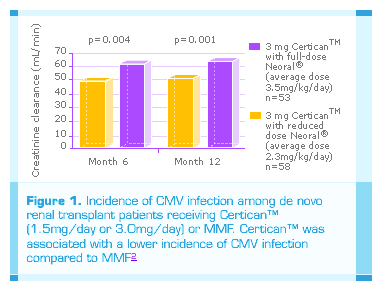
Decreasing CNI-related nephrotoxicity
Certican™ is highly effective when used in combination with Simulect®
and reduced-dose Neoral®. This regimen reduces CNI-related nephrotoxicity
compared to a combination of Certican™, Simulect® and full-dose Neoral®
(Figure 1) 3.
 Fewer
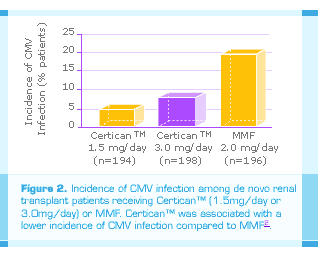
CMV infections associated with Certican™
CMV and other viral infections increase the risk of chronic rejection.
Certican™ is associated with a lower incidence of opportunistic CMV infections
when compared to MMF. Data at 12 months have shown that patients administered
Certican™ (1.5mg/day) had a substantially lower incidence of CMV infection
compared to patients receiving MMF (2mg/day) (Figure 2) 2.
Inhibiting vascular remodelling
The common histological feature of chronic rejection is concentric
intimal thickening of vessels, resulting from proliferation of smooth
muscle cells in response to vascular damage 5.
This in turn can lead to vessel occlusion and reduced blood supply. Certican™
helps directly to inhibit vascular remodelling and intimal thickening
4.
Pharmacokinetics of Certican™
Certican™ has a favourable pharmacokinetic profile:
Absorbed rapidly (within 2 hours) 6
Dose-proportional absorption over the clinically relevant range 7
Half-life of 16-19 hours (dose 0.75-7.5mg/day), which is shorter than
that of rapamycin 6
Steady-state is reached after approximately 4 days (dose 0.75-7.5mg/day)
6,
7
Concomitant administration with Neoral®
Optimal combination therapy with Neoral®
Certican™ works in a complementary manner with Neoral® to suppress
T-lymphocyte proliferation. Combination therapy using Certican™ and optimally-dosed
Neoral® would therefore be expected to offer excellent graft protection
with the potential for reduced toxicity 4.
During the Phase III renal studies of Certican™, it became apparent that
renal function may be reversibly impaired in a subset of patients when Certican™
is used in conjunction with full-dose Neoral®. This effect was comparable
to the elevations of serum creatinine seen with sirolimus, another signal proliferation
inhibitor in the same class of drug, and is most likely an effect of Neoral®.
Elevations were reversible when the Neoral® dose was reduced.
This led to the understanding that Neoral® dose may require adjustment when
used in conjunction with Certican™.
The optimal combination of Neoral® and Certican™ has been investigated
in an open-label multicentre trial 9
of 111 de novo renal transplant patients who were treated as follows:
All patients received Certican™ 3mg/day, Simulect® and methylprednisolone
Randomised to full-dose Neoral® (6-8mg/day, n=57) or reduced-dose Neoral®
(3-4 mg/day, n=54). Neoral® dosing was adjusted to maintain pre-defined
trough levels:
| High-dose group 150-300 ng/mL (months 1-2) |
150-300 ng/mL (months 1-2) |
| 125-250 ng/mL (months 3-36) |
| Reduced-dose group |
75-125 ng/mL (months 1-2) |
| 50-100 ng/mL (month 3-36) |
|
 Clinical
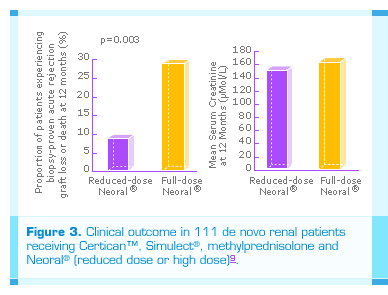
outcomes were excellent 9:
the 12-month incidence of a combined end-point of biopsy-proven acute
rejection, graft loss or death was 27.8% in the full-dose Neoral®
group and 8.8% in the reduced-dose group (p=0.013) (Figure 3). Symptoms
of drug toxicity and discontinuation of the study due to adverse events
were lower in the reduced-dose Neoral® group (5% vs 22%).
Moreover, mean serum creatinine levels were lower in the reduced-dose
Neoral® group (151µmol/L) than the full-dose group
(161µmol/L).
In summary, this trial 9
demonstrated that Certican™ in combination with low-dose Neoral®, Simulect®
and steroids achieves a very low rate of acute rejection with excellent graft
survival, and is associated with improved renal function compared to combination
with full-dose Neoral®.
Adverse event profile
Studies in over 3,200 patients have shown that Certican™ is an effective
and generally safe immunosuppressive agent. A 6-month study 10
of Certican™ in de novo renal transplant patients demonstrated that it
is well tolerated with a low rate of opportunistic infections. Haematological
changes and moderate increases in lipids were seen but these effects were manageable.
In a study of paediatric recipients 11
aged 3-14 years, single-dose Certican™ was also found to be well tolerated.
Current status
The Certican™ dossier is currently being prepared for regulatory approval.
|