|
|
Neoral®: improved absorption
of cyclosporin.
|
|
 |
|
Neoral® uses a unique microemulsion
delivery system to optimise absorption of cyclosporin.
The introduction of the Neoral®
formulation significantly improved the bioavailability
(area under the curve) and the peak concentration
of cyclosporin compared to the original oil-based
formulation, Sandimmun®1,2.
|
|
|
|
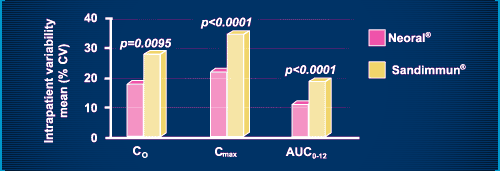
Importantly, use of Neoral® also
reduces variability of absorption so that delivery
of cyclosporin is more reliable within a patient
(Figure 1)1,2,3. Total cyclosporin
absorption, Cmax (peak concentration)
and tmax (time to peak) are all significantly
more reproducible with Neoral®
than with Sandimmun® 3.
|
|
|
|
Figure 1. Neoral®
reduces intrapatient variability of cyclosporin
absorption compared to Sandimmun®,
indicating more reproducible levels of immunosuppression
(C0, trough cyclosporin level; Cmax,
peak cyclosporin level; AUC0-12, cyclosporin
absorption in 12 hours post-dose)3
|
|
 |
|
|
|
|
|
|
Impact of Neoral® pharmacokinetics
|
|
|
|
The improved absorption of cyclosporin from Neoral®
has resulted in improved outcomes for patients
compared to the Sandimmun® formulation4,5.
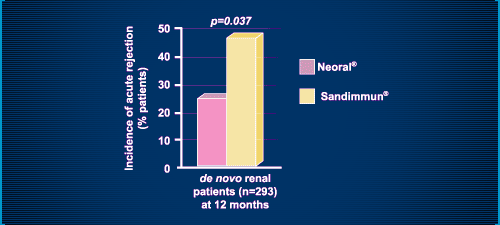
The incidence of acute rejection is significantly
lower in renal patients treated with Neoral®
compared to those receiving Sandimmun®
(Figure 2)4.
|
|
|
|
Figure 2. Neoral®
significantly reduces the risk of acute rejection
compared to Sandimmun® in de
novo renal transplant recipients4
|
|
|
|
|
|
|
|
|
|
|
Understanding pharmacokinetics improves
monitoring
|
|
|
|
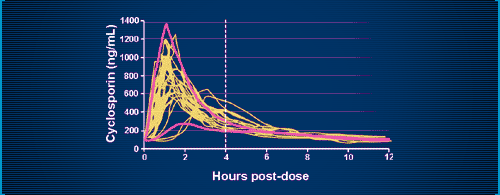
Recent data6 have shown that both
intrapatient and interpatient variability with
Neoral® is greatest during the
first 4 hours after the Neoral®
dose (Figure 3). Monitoring
during this 4-hour period is likely to give the
best indication of Neoral absorption.
|
|
|
|
Figure 3. Cyclosporin pharmacokinetic
profiles in individual patients receiving Neoral®.
Pharmacokinetic variability is greatest during
the absorption phase (up to 4 hours post-dose)
|
|
|
|
|
|
|
|
Further pharmacokinetic analysis7,8,9
has demonstrated that measuring
cyclosporin concentration at C2
(2 hours post-dose) provides a sensitive and accurate
measure of Neoral® absorption and
can result in improved clinical outcomes.
|
|
|
|
|
|
|
Comparison of pharmacokinetics with
tacrolimus
|
|
|
|
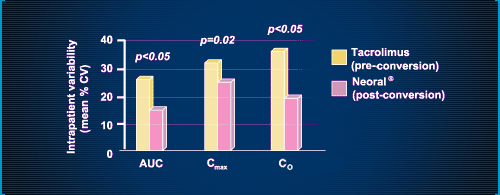
Higgins et al10 have compared the
pharmacokinetic variability of Neoral®
to tacrolimus, the only other commercially-available
calcinuerin inhibitor. Results10 showed
that cyclosporin in the form of Neoral®
exhibited significantly less interpatient and
intrapatient variability than tacrolimus (Figure
4).
|
|
|
|
Figure 4: Pharmacokinetic intrapatient
variability in 15 stable renal transplant patients
converted from tacrolimus to Neoral®.
Intrapatient variability was significantly lower
with Neoral® than tacrolimus10.
|
|
|
|
|
|
|
|
|
|
|
Importance of formulation
|
|
|
|
It is important that patients are not transferred
to a different formulation of cyclosporin without
careful comparison of their relative pharmacokinetic
profiles and bioequivalence considerations.
|
|
|
|
|
|
|
1.
|
Kovarik JM, Mueller EA, van
Bree JB et al. Cyclosporine pharmacokinetics
and variability from a microemulsion formulation-a
multicenter investigation in kidney transplant
patients. Transplantation 1994; 58:
658-63
|
|
2.
|
Mueller EA, Kovarik JM, van
Bree JB et al. Pharmacokinetics and tolerability
of a microemulsion formulation of cyclosporine
in renal allograft recipients-a concentration-controlled
comparison with the commercial formulation.
Transplantation 1994; 57: 1178-82
|
|
3.
|
Kahan BD, Dunn J, Fitts C et
al. Reduced inter- and intrasubject variability
in cyclosporine pharmacokinetics in renal
transplant recipients treated with a microemulsion
formulation in conjunction with fasting,
low-fat meals, or high-fat meals. Transplantation
1995; 59: 505-511
|
|
4.
|
Pollard S, Lear PA, Ready AR
et al. Comparison of microemulsion and conventional
formulations of cyclosporine A in preventing
acute rejection in de novo kidney
transplant patients. Transplantation
1999; 68: 1325:1331
|
|
5.
|
Otto M-G, Mauer AD, Clavien
P-A et al. Randomized trial of cyclosporine
microemulsion (Neoral) versus conventional
cyclosporine in liver transplantation. Transplantation
1998; 66: 1632-16406
|
|
6.
|
Johnston A, David OJ, Cooney
GF. Pharmacokinetic validation of Neoral
absorption profiling. Transplant Proc
2000; 32 (Suppl 3A); 53S-56S
|
|
7.
|
Barama A, Perner F Beauregard-Zollinger
L et al. Absorption profiling of cyclosporine
therapy for de novo kidney transplantation:
a prospective randomized study comparing
sparse sampling to trough monitoring. Transplantation
2000; 69: S162. Abstract 190
|
|
8.
|
Mahalati K, Belitsky P, Sketris
I et al. Neoral monitoring by simplified
sparse sampling area under the concentration-time
curve. Transplantation 1999; 68:
55-62
|
|
9.
|
Cantarovich M, Besner J-G,
Barkun JS et al. Two-hour cyclosporine level
determination is the appropriate tool to
monitor Neoral therapy. Clin Transplant
1998; 12: 243-249
|
|
10.
|
Higgins RM, Hart P, Lam FT
et al. Conversion from tacrolimus to cyclosporine
in stable renal transplant patients. Transplantation
2000; 69: 1736-9
|
|
|
|