|
It has recently become clear that monitoring
cyclosporin concentration during the absorption
of Neoral® can deliver significant
clinical benefits for patients compared to conventional
C0 monitoring
|
|

|
|
A landmark prospective trial4 of 55
de novo renal transplant patients demonstrated
an acute rejection rate of 3% in patients who
achieved target AUC0-4 range early
(Figure 2). No patient who achieved the target
AUC0-4 range and remained within it
experienced nephrotoxicity.
|
|
|
|
Figure 2. Incidence of acute
rejection at 3 months in 55 renal transplant
patients stratified according to whether
target Neoral® absorption
(AUC0-4 4400-5500ng.h/mL) was
achieved by Day 3 post-transplant (mRIA
assay). In the group achieving target Neoral®
absorption, the incidence of acute rejection
was 3%4.
|
|
|
|
|
|
|
|
In maintenance patients, results
from a study5 of renal transplant recipients
more than three months post-transplant has shown
that C2 monitoring can reveal cyclosporin
over-exposure which remains undetected by C0
monitoring. A high proportion of patients managed
by C0 monitoring had cyclosporin levels
above the C2 target level, leading
to the possibility of Neoral® dose
reduction using C2 monitoring5.
|
|
|
|
More
information about Neoral® C2
monitoring in de novo and maintenance patients.
|
|
|
Comparison with tacrolimus
|
|
|
Comparative trials with tacrolimus to date have
only used Neoral® C0
monitoring; no results are available which directly
compare tacrolimus to Neoral® C2
monitoring.
|
|
|
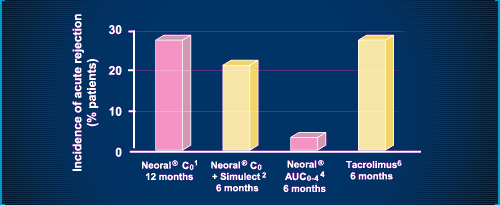
Figure 3 summarises the acute rejection rates
reported in four recent trials of Neoral®
and tacrolimus in renal transplantation (see Table
1 for details).
|
|
|
Figure 3. Incidence of acute
rejection in de novo renal transplant
patients receiving different immunosuppression
and monitoring.
|
|
|
|
|
|
|
Table 1. Study details for de
novo renal transplant patients receiving different
immunosuppression and monitoring. (* Received
steroids and azathioprine, rapamycin, RAD or MMF)
|
|
|
Immunosuppression
& monitoring
|
Number of patients
|
Data collection
period
|
Acute rejection
rate
|
Reference
|
|
Neoral® C0
(no i.v. cyclosporin)
± azathioprine
steroids
|
195
|
12 months
|
27%
|
1
|
|
Neoral® C0
+ Simulect®
+ azathioprine
+ steroids
|
340
|
6 months
|
21%
|
2
|
|
Neoral®
AUC0-4
|
55
|
6 months
|
3%
|
4
|
|
Tacrolimus
+ azathioprine
+ steroids
|
557
|
6 months
|
20%
|
6
|
|
|
 |
|
|
1.
|
Pollard SG, Lear PA, Ready
AR et al. Comparison of microemulsion and
conventional formulations of cyclosporine
A in preventing acute rejection in de
novo kidney transplant patients. Transplantation
1999; 68: 1325-1331
|
|
2.
|
Ponticelli C, Yussim A, Cambi
V et al. Basiliximab (Simulect) significantly
reduces the incidence of acute rejection
in renal transplant patients receiving triple
therapy with azathioprine. Transplantation
2000; 69 (Suppl): S156. Abstract 166
|
|
3.
|
Nashan B, Moore R, Amlot P.
Randomised trial of basiliximab versus placebo
for control of acute cellular rejection
in renal allograft recipients. Lancet
1997; 350: 1193-1198
|
|
4.
|
Mahalati K, Belitsky P, West
K et al. Approaching the therapeutic window
for cyclosporine in kidney transplantation:
a prospective study. J Am Soc Neph 2001;
12:823-833
|
|
5.
|
Cole E et al. Conversion of
stable renal transplant recipients from
cyclosporin microemulsion trough (co)
to C2 monitoring: implications
for exposure. Joint meeting of AST/ASTS.
Chicago, May 2001. Abstract 992
|
|
6.
|
Margreiter R, the European
Tacrolimus vs Ciclosporin-Microemulsion
Renal Transplantation Study Group. A prospective,
randomized multicenter study to compare
the efficacy and safety of tacrolimus and
ciclosporin-microemulsion in renal transplantation.
Transplantation 2000; 69: S112. Abstract
8
|
|
|
|