|
The role of the IL-2 receptor in allograft rejection
|
|

|
|
Interleukin-2 (IL-2) and the IL-2 receptor have a predominant
role in the immunogenic reaction to transplantation1.
|
|
|
|
During an immune response, such as rejection of a transplanted
organ, IL-2 stimulates rapid proliferation of T-lymphocytes
by binding to IL-2 receptors on T-lymphocytes which
have been activated by the presence of antigen.
|
|
|
|
The IL-2 receptor includes three protein chains: α
(CD25), β (CD122) and γ (CD132). In resting
T-lymphocytes, the level of expression of CD25 is low.
However, stimulation of T-lymphocytes by antigen induces
expression of CD25. CD25 is responsible for the rapid
association of IL-2 with the β and γ chains
- which in turn triggers profileration of T-lymphocytes1.
|
|
|
|
An understanding of this pathway led to the identifcation
of CD25 as an important target for selective inhibition
by monoclonal antibody therapy.
|
|
|
|

|
|
|
|
Simulect®: a high-affinity selective
CD25 monoclonal antibody
|
|
|
|
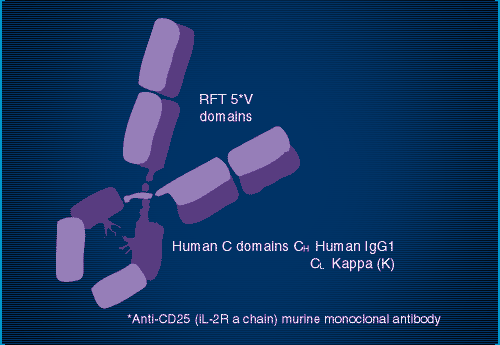
Mouse monoclonal antibodies (such as OKT3) are more
specific than polyclonal antibody preparations such
as ALG. However, mouse antibodies are highly immunogeneic
and commonly induce a human anti-murine antibody response
after administration. Simulect® overcomes
this problem through chimerisation. It is a human/mouse
chimeric monoclonal antibody2 which contains
the variable regions of a mouse anti-CD25 mouse antibody
(RFT5) and the constant regions of human immunoglobulin
(Figure 1).
|
|
|
|
Figure 1. Structure of the Simulect®
molecule. Simulect® combines anti-CD25
mouse antibody (RFT5) with human constant domains.
|
|
|
|
|
|
|
As a result1,2 of this chimeric structure:
|
|
|
|
Simulect® retains the original
specificity of the intact mouse molecule without
loss of affinity. This means that potency against
CD25 is retained, but Simulect®
does not affect resting T-lymphocytes since these
do not express CD25. It also allows Simulect®
to be effective using a convenient two-dose regimen.
|
|
|
The human anti-murine antibody response is dramatically
reduced due to replacement of mouse constant regions
with human counterparts, resulting in minimal
immunogenicity.
|
|
|
|
|
|
|
|
|
Complete CD25 suppression
|
|
|
As a result of this unique structure, Simulect®
achieves complete suppression of CD252,3,
competing effectively with IL-2 at the IL-2 receptor1.
This in turn inhibits IL-2-driven T-lymphocyte growth
and proliferation.
|
|
|
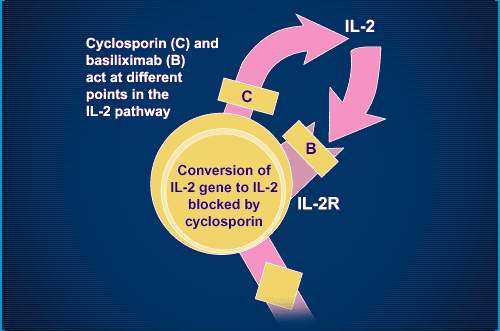
Simulect® complements the immunosuppressive
effect of Neoral®. Neoral®
suppresses IL-2 production and release, thus targeting
quiescent lymphocytes, while Simulect®
prevents binding of IL-2 to the IL-2 receptor - thus
targeting activated lymphocytes (Figure 2).
|
|
|
Figure 2. Simulect®
(basiliximab, B) and Neoral® (cyclosporin,
C) act in a complementary way to block the IL-2
pathway. Simulect® acts by preventing
the binding of IL-2 to the IL-2 receptor on activated
T-cells, resulting in activation of T-cell growth
and proliferation.
|
|
| |
|
|
|
|
|
The pharmacokinetics
of Simulect® (in particularly a long
terminal half-life) mean that suppression of CD25 continues
for 4-6 weeks after administration of two 20mg doses
of Simulect® on Day 0 and Day 4, i.e.
the period when risk of rejection is highest.
|
|
|
|
|
|
|
|
1.
|
Nashan B, Moore R, Amlot P et al.
Randomised trial of basiliximab versus placebo
for control of acute cellular rejection in renal
allograft recipients. Lancet 1997; 350:
1193-98
|
|
2.
|
Amlot PL, Rawlings E, Fernando ON
et al. Prolonged action of a chimeric interleukin-2
receptor (CD25) monoclonal antibody used in cadaveric
renal transplantation. Transplantation
1995; 60: 748-56
|
|
3.
|
Kovarik JM, Rawlings E, Sweny P et
al. Prolonged immunosuppressive effect an minmal
immunogenicity from chimeric (CD25) monoclonal
antibody SDZ CH1 621 in renal transplantation.
Transplant Proc 1996; 28: 913-14
|
|
|
|
|
|