|
|
Adult renal transplantation Diabetic
transplant recipients
Living donor
transplantation Paediatric
transplantation
|
|
 |
|
Simulect® has been evaluated in multicentre,
randomised, double-blind studies in conjunction with:
|
|
|
|
Neoral® triple therapy (Neoral®,
steroids and azathioprine)1,2
|
|
|
Neoral® double therapy (Neoral®
and steroids)3,4
|
|
|
|
In each trial, addition of Simulect®
resulted in a significant reduction in the incidence
of acute rejection (28-40%), with no difference in side
effects from the placebo study arms1,2,3,4.
|
|
|
|
Simulect® addition to Neoral®
triple therapy
|
|
|
|
Simulect® & Neoral®,
steroids, azathioprine
|
|
|
In an international trial1 carried out in
12 countries, 340 renal transplant patients were treated
with Neoral®, steroids and azathioprine
and randomised to receive placebo or Simulect®
(20mg i.v. bolus on Day 0 and Day 4 post-transplant).
At six months:
|
|
|
|
The incidence of acute rejection was 21% with
Simulect® compared to 35% with
placebo (p=0.005) (Figure 1)
|
|
|
The incidence of infection was similar in both
groups, with no difference in CMV infection. There
was one case of malignancy in the Simulect®
group, and three in the placebo group, with no
lymphoma
|
|
|
Bolus injections of Simulect®
were well tolerated and there was no difference
in the pattern of adverse events
|
|
|
|
Figure 1. Incidence of acute rejection
in 340 renal patients randomised to receive Simulect®
or placebo with Neoral®, steroids
and azathioprine1
|
|
|
|

|
|
|
Simulect® & Neoral®,
steroids & MMF
|
|
|
A similar protocol was used for a multi-centre, double-blind
study2 of 123 renal transplant patients randomised
to Simulect® or placebo in conjunction
with Neoral®, steroids and 2-3g/day mycophenolate
mofetil (MMF).
|
|
|
Acute rejection was reduced by 42.5% in the Simulect®
arm compared to placebo, and there was no difference
in adverse event profile between the two groups2.
|
|
|
|
|
|
Simulect®: addition to Neoral®
double therapy
|
|
|
|
The effectiveness and safety of Simulect®
in addition to Neoral® double therapy
(Neoral® and steroids) has been demonstrated
in two large multicentre studies. One of these was conducted
internationally (n=380)3 and the other was
undertaken in the United States (n=348)4.
The results of both trials were similar:
|
|
|
|
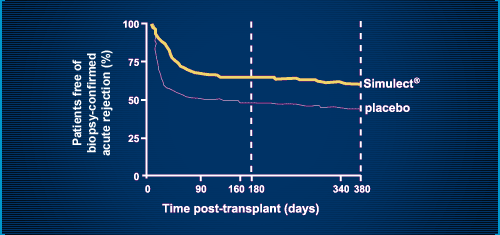
The incidence of biopsy-confirmed acute rejection
at 6 months was significantly lower in the Simulect®-treated
patients than in the placebo group. The international
study3 found a reduction of 32% (30%
acute rejection vs 44%, p=0.012) (Figure 2) and
the US study4 showed a reduction of
28% (33% vs 46%, p=0.017)
|
|
|
In both trials, Simulect® showed
an adverse event profile similar to placebo
|
|
|
|
Figure 2. Proportion of patients
remaining free of acute rejection among 380 de
novo renal transplant patients randomised
to receive Simulect® or placebo
in addition to Neoral® and steroids3.
|
|
|
|
|
|
|
|
|
|
|
1.
|
Ponticelli C, Yussim A, Cambi V et
al. Basiliximab (Simulect) significantly reduces
the incidence of acute rejection in renal transplant
patients receiving triple therapy with azathioprine.
Transplantation 2000; 69 (Suppl): S156.
Abstract 166
|
|
2.
|
Lawen J, Davies E, Mourad G, Oppenheimer
F et al. Basiliximab (Simulect®)
is safe and effective in combination with triple
therapy of Neoral®, steroids and
Cellcept® in renal transplant recipients.
Transplantation 2000; 69 (Suppl): S260-1
|
|
3.
|
Nashan B, Moore R, Amlot P et al.
Randomised trial of basiliximab versus placebo
for control of acute cellular rejection in renal
allograft recipients. Lancet 1997; 350:
1193-98
|
|
4.
|
Kahan BD, Rajagopalan PR, Hall M.
Reduction of the occurrence of acute cellular
rejection among renal allograft recipients treated
with basiliximab, a chimeric anti-interleukin-2-receptor
monoclonal antibody. Transplantation 1999;
67: 276-284
|
|
|
|