|
|
Adult renal
transplantation Diabetic
transplant recipients
Living donor transplantation Paediatric
transplantation
|
|
 |
|
Addition of Simulect® to a Neoral®-based
regimen provides significant clinical benefits for patients
who receive living donor kidneys as well as those receiving
cadaveric transplants.
|
|
|
|
A retrospective analysis of results1 from
the US Simulect Study of 346 renal transplant recipients,
in which 105 transplants were from living donors, has
shown that:
|
|
|
|
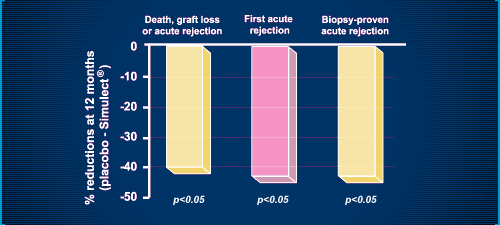
A combined end-point of death, graft loss or
first rejection at six months was reduced by 40%
in living donor recipients receiving Simulect®
compared to those given placebo (p<0.05) (Figure
1)
|
|
|
First acute rejection was significantly reduced
by 43% in living donor recipients treated with
Simulect® (p<0.05)
|
|
|
Biopsy-confirmed acute rejection was 43% lower
in living donor patients receiving Simulect®
compared to placebo (p<0.05)
|
|
|
|
Figure 1. Reduction in clinical events
at six months in living donor renal transplant
recipients receiving Simulect®.
Results are shown as the percentage reduction
compared to patients randomised to placebo1.
|
|
|
|
|
|
|
There were no clinically relevant differences in the
incidence, profile or severity of adverse events or
infections, including CMV, between the Simulect®
and placebo groups in either the living donor or cadaveric
populations1.
|
|
|
|
|
1.
|
Mulloy LL, Wright F, Hall ML et al.
Simulect (basiliximab) reduces acute cellular
rejection in renal allografts from cadaveric and
living donors. Transplant Proc 1999; 31:
1210-1213
|
|
|
|