|
|
Adult renal
transplantation Diabetic
transplant recipients
Living donor
transplantation Paediatric
transplantation
|
|
 |
|
The clinical advantages of Simulect®
have been demonstrated1 in diabetic recipients
of renal transplants, and are at least equivalent to
the benefits shown in non-diabetic patients.
|
|
|
|
Data from 722 renal transplant patients randomised
to receive placebo or Simulect® in combination
with Neoral® and steroids have been analysed
retrospectively1. One hundred and fifty of
these patients had diabetes mellitus prior to transplantation.
Results showed higher graft survival in diabetic recipients
treated with Simulect® compared to those
receiving placebo (96% vs 86%, p=0.022).
|
|
|
|
Additionally, the analysis1 demonstrated:
|
|
|
|
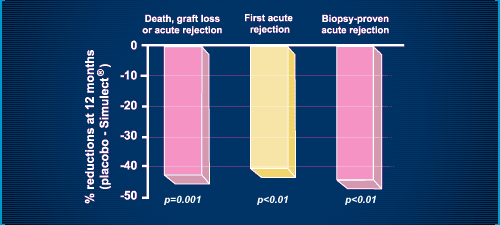
Incidence of first treated acute rejection was
41% lower in the Simulect® group
compared to the placebo-treated patients (p<0.01)
|
|
|
A combined end-point of death, graft loss or
first rejection was 43% lower in diabetics receiving
Simulect® compared to placebo(p=0.001)
|
|
|
Biopsy-confirmed acute rejection was 44% lower
at 12 months in diabetic patients receiving Simulect®
compared to placebo (p<0.01)
|
|
|
|
Figure 1. Reduction in clinical events
at 12 months in diabetic renal transplant recipients
receiving Simulect®. Results are
shown as the percentage reduction compared to
patients randomised to placebo1.
|
|
| |
|
|
|
|
|
There was no significant difference in adverse events
between the Simulect® and placebo cohorts.
|
|
|
|
|
1.
|
Thistlethwaite JR, Nashan B, Hall
M et al. Reduced acute rejection and superior
1-year renal allograft survival with basiliximab
in patients with diabetes mellitus. Transplantation
2000; 70: 784-790
|
|
|
|